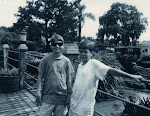
Here is another band, Sin Recursos.
"Contra Reloj"
Live at the Latin American Festival 2009
http://www.youtube.com/watch?v=Vrxv7cNgVDM
Monday, February 1, 2010

Band Videos- Bakalao Stars
Here's a couple of videos from another band, Bakalao Stars.
"Pinocho"
"Momentos Kodak"
"Pinocho"
"Momentos Kodak"
Band Videos-La Rua
I thought I might post some youtube videos of some of the local Latino bands playing music in Charlotte. First up, La Rua. These guys have moved on to other projects, but they influenced a lot of the other rock bands singing in Spanish here.
"El Chanchito"
"La Jeva"
"El Chanchito"
"La Jeva"
Friday, January 29, 2010
A Literary Detour
By popular request (meaning I got a text from my moms about it), I have decided to write about a non-musical theme. The recent deaths of Howard Zinn and J.D. Salinger created a stir this week. However, I was surprised by how much praise Salinger received, overshadowing a discussion of Zinn's body of work. For example, the New York Times online version had a lead story about Salinger, while Zinn showed up only in the obituaries section. People who did pair them together, as in friends' facebook status updates, did so in a manner that made them seem compatible. I strongly disagree with this assertion.
First, J.D. Salinger.
I was required, like almost everybody in the US, to read "The Catcher in the Rye" for school. I thought it was god-awful. I never understood why a book about a disaffected adolescent from a privledged background who decides to wander around New York City after being expelled from prep school got so much praise. It just never seemed like that great of a book to me, neither the quality of writing nor the narrative impressed me. I think it ranks a distant third or fourth in an outdated genre of books about young (male) protagonists struggling to find a place while fighting the establishment (as they said back then), father figures, each other, and life's daily tragedies (everything's dramatic when you're 15). For example, "The Outsiders," "Lord of the Flies," or 'Great Expectations" fit this mold, but each presents us with some sort of moral issue in comparison to Holden's distant infantilism. These are all books that I think teachers and administrators though it would be good for us kids to read and learn valuable life lessons, while, as Howard Zinn might comment, the more valuable lessons came from the defunding of education and social welfare, the militarism displayed by nuclear posturing and the war on drugs, and the misinterpretations and erasures of significant cultural contributions and historical facts in daily classroom interactions. As my seventh grade social studies teacher once said, the Civil War was not about slavery at all (States Rights!). The commentaries about Salinger almost uniformly compared Catcher to another great American novel, Mark Twain's "Huck Finn," but I think if Huck ran into Holden in the street, he might tell him to stop whining about everybody being phony or wallowing in pity and actually leave the prison of his psyche to do something truly adventurous or heroic, like, say, helping a slave escape down river, or having fun playing adults for the fool.
Second, Howard Zinn. A popular historian in that many people read his work, he wrote history that anyone could understand, and that he eschewed the 'great man' theory of history to talk about ordinary peoples' lives. As someone who has read a lot of history books ( I was a history major in college), Zinn hit the important stuff, but in the interest of making his work accessible often left out some of the nuance and sidebars of US history, for better or worse (you decide). His was an anti-imperialist, anti-racist reading of history that paid attention to class struggles and revealed many of the erasures wrought by attempts to present a teleology of American world supremacy. Zinn, much like Studs Terkel, believed in giving ordinary people a voice and inviting them to participate by telling their own stories.
But perhaps most telling is Zinn's public life; he decided to actively participate in the struggles of his time, while Salinger turned inwards. While Zinn's life remains an open book, we may never know why Salinger became a recluse, perhaps this is why people obsess. I continue to be unimpressed.
Tuesday, January 26, 2010

Ultima Nota


On Saturday, I went to go see a band, Ultima Nota, play at a Cuban restaurant in suburban Charlotte. Ultima Nota plays a mix of rock, bossa nova, boleros, and other Latin styles, covering popular songs in both English and Spanish. Or what could be called cheesy, dinner/lounge music. While it might seem like sort of a drag, the music actually sounds interesting, because they tend to change the songs up and make them their own.
What draws my attention is how gracefully they blend what might seem like disparate musical styles, playing North American pop songs like Michael Jackson's "Billie Jean" with Latin American hits like Juan Luis Guerra's "Burbujas de Amor." A salsa classic follows an American pop ballad, a rock en espanol cover comes after their interpretation of Bob Marley's "I Shot the Sheriff." But what I find out when I talk and hang out with musicians is that these are the songs they grew up with. These songs are becoming "standards" in the sense of jazz standards because everyone knows them and the songs' structures lead to easy reinterpretation. Although you may never hear these songs played back to back on the radio or pandora, here they coexist easily.
Southern Folklife Collection
http://www.lib.unc.edu/mss/sfc1/
For anyone interested in southern music, particularly if you want to hear some of the early stuff, I recommend taking a look at this site, the Southern Folklife Collection homepage. Even if you can't make it to the actual library, they have five "SFC Radio" streams where you can listen to music from the collections on your computer.
For anyone interested in southern music, particularly if you want to hear some of the early stuff, I recommend taking a look at this site, the Southern Folklife Collection homepage. Even if you can't make it to the actual library, they have five "SFC Radio" streams where you can listen to music from the collections on your computer.
Subscribe to:
Posts (Atom)